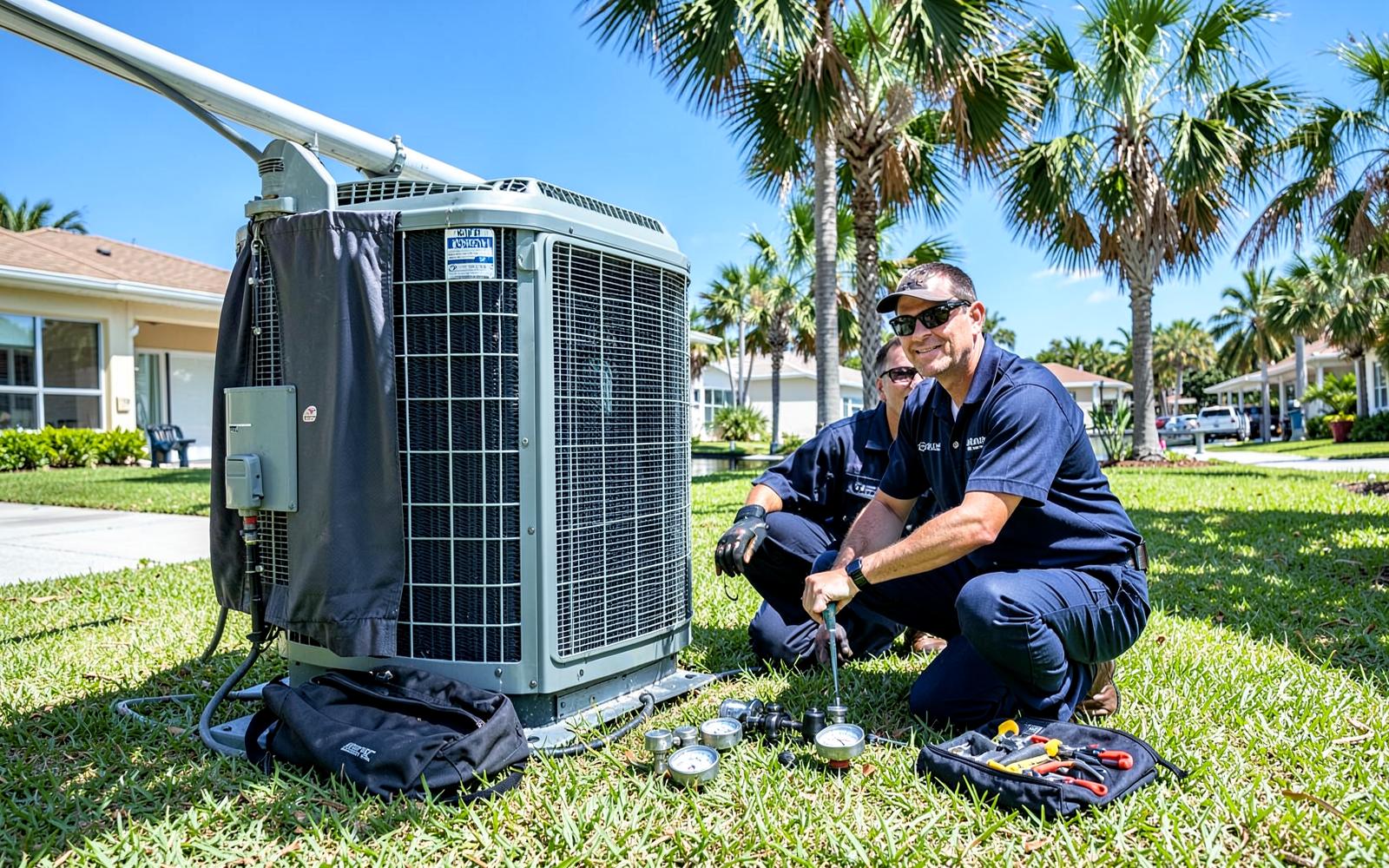
Sandpiper Bay borders the St. Lucie River, and that waterfront setting is a defining factor for outdoor air conditioning equipment in the neighborhood. Outdoor equipment closer to waterways and coastal air can experience additional corrosion on condenser fins, electrical terminals, and cabinet fasteners compared with equipment further inland, though the degree varies by exact location and how exposed a given outdoor unit is.
Many homes in Sandpiper Bay date to the 1970s and 1980s, so ductwork and electrical service in these properties are often older than whatever cooling equipment is currently attached to them, particularly on homes where the condenser has been replaced more recently than the rest of the home's systems.
AC repair information and service requests cover Port St. Lucie and the areas listed below, including Sandpiper Bay. Homeowners near the water in this area often deal with a combination of age-related wear from the home's original construction era and accelerated wear on outdoor components tied to the waterfront setting.
Housing in Sandpiper Bay
Established single-family homes and waterfront properties, many built in the 1970s and 1980s.
Sandpiper Bay's housing stock reflects the era in which the St. Lucie River waterfront was first developed, with many single-family homes dating to the 1970s and 1980s alongside the Sandpiper Bay Resort area. Original construction from this period typically has more modest attic insulation levels than current code requires, and some homes have had only partial updates to ductwork over the decades.
Because waterfront and near-waterfront lots are more exposed to humid air moving off the river, homes in Sandpiper Bay generally face a higher latent cooling load than comparable inland properties, meaning the air conditioning system does proportionally more work removing moisture rather than just lowering temperature.
Cooling considerations specific to Sandpiper Bay
- Outdoor equipment closer to waterways and coastal air can experience additional corrosion on coils, fasteners, and electrical terminals
- More frequent coil rinsing can help slow corrosion-related wear in homes near the water
- Older homes in the area often have limited attic insulation and ductwork that has not been fully updated
- Higher ambient humidity near the river increases the latent, moisture-removal portion of the cooling load
- Homes built in the 1970s and 1980s may still have original electrical service that is worth reviewing before a system replacement
Common AC problems that may occur in Sandpiper Bay
- Corrosion on outdoor coils and electrical terminals
- Homes closer to the St. Lucie River can see faster corrosion on condenser fins and outdoor electrical connections than inland properties, which may eventually affect performance or reliability if left unaddressed.
- Older ductwork limiting overall performance
- Ductwork dating to original 1970s or 1980s construction may have degraded insulation or leaks that reduce the effective performance of even a newer condenser or air handler.
- Elevated indoor humidity near the water
- The higher ambient humidity common near the river can leave a home feeling damp even when the thermostat is satisfied, particularly if the system does not run long enough per cycle to remove adequate moisture.
- Original electrical service limitations
- Some homes from this construction era still have original electrical panels that may need review to confirm they can adequately support a modern replacement system.
Safe checks before requesting service
- Set the thermostat fan setting to Auto rather than On, which generally improves moisture removal during the cooling cycle
- Change the air filter regularly, since coastal humidity can contribute to faster filter loading
- Rinse visible debris and salt residue off the outdoor unit's exterior cabinet with a garden hose when it appears dusty or crusted, avoiding electrical components
- Check the condensate drain line outlet outside for consistent dripping during operation, which is normal, versus no drainage at all, which can indicate a clog
- Confirm supply vents are open throughout the home to support even airflow
- Reset a single tripped breaker once only; repeated tripping indicates a need for professional electrical evaluation
Internal coil cleaning, electrical work, refrigerant work, and panel removal should be left to qualified service personnel.
Repair and maintenance considerations
Because corrosion-related wear from waterfront exposure tends to progress gradually, many Sandpiper Bay homeowners find that consistent maintenance, rather than reactive repair alone, meaningfully extends how long outdoor equipment performs reliably. A system that receives regular coil cleaning and electrical inspection is generally less likely to experience the sudden failures that heavier corrosion can eventually cause.
That said, homes with original 1970s or 1980s ductwork often reach a point where duct condition, not the condenser, is the limiting factor on comfort. In these cases, repairing or replacing the outdoor unit alone may not resolve uneven cooling or humidity complaints, and a broader look at the duct system is a reasonable next step alongside any equipment repair.
Landmarks and corridors in Sandpiper Bay
Local reference points include St. Lucie River, Sandpiper Bay Resort area, SE Westmoreland Boulevard.
Nearby areas
AC repair services relevant to Sandpiper Bay
- AC Repair
- Emergency AC Repair
- AC Not Cooling
- AC Maintenance and Tune-Ups
- Refrigerant Leak Repair
- Air Handler and Blower Repair
- Thermostat Repair and Installation
- Condenser and Coil Cleaning
- Ductwork and Airflow Repair
- AC Replacement and Installation
- AC Capacitor Repair
- AC Compressor Repair
- AC Drain Line Repair
- Frozen AC Repair