
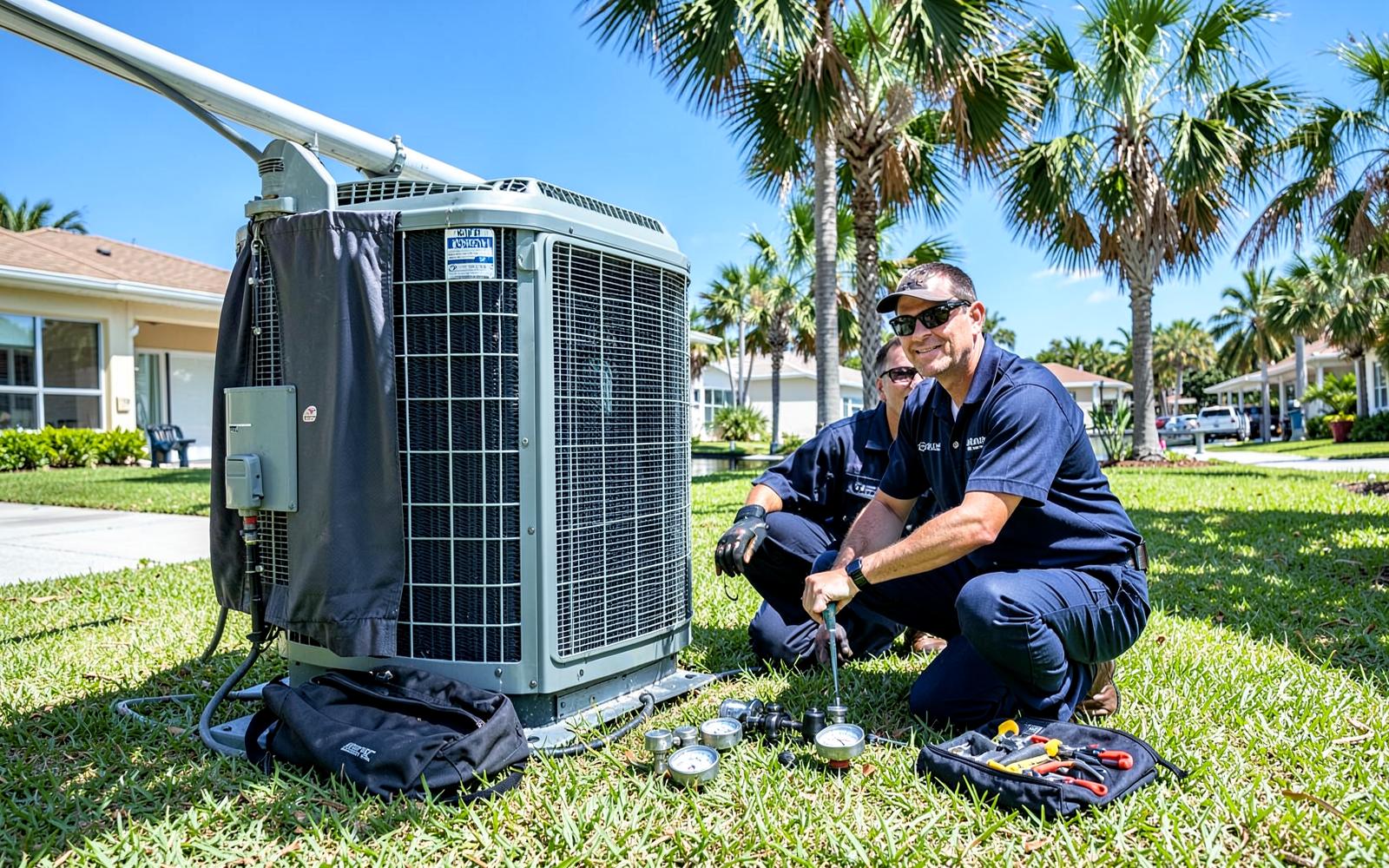
St. Lucie West is a large master-planned area developed mainly through the 1990s and early 2000s, anchored by St. Lucie West Boulevard and the commercial corridor near I-95. Much of the original HVAC equipment installed when these homes were built has already been replaced once, and many of those second-generation systems are now themselves reaching an age where repairs become more frequent.
The area includes a wide range of housing types, from single-family subdivisions to townhomes and condominium communities, many of which are gated or governed by a homeowners association. Lot layouts in several of these communities place condensers along narrow side yards between adjacent homes, which affects both airflow clearance around the unit and physical access for inspection or repair.
AC repair information and service requests cover Port St. Lucie and the areas listed below, including St. Lucie West. Because the neighborhood is now three decades into its development, homeowners here are more likely than those in newer parts of the city to be dealing with a second or third generation of cooling equipment, along with original ductwork that may not have been updated at the same time.
Housing in St. Lucie West
Single-family homes, townhomes, and condominiums built largely between 1990 and 2005.
St. Lucie West's housing stock is more varied than many single-builder subdivisions, reflecting its development across multiple builders and phases through the 1990s and into the early 2000s. Many communities are gated, with condominium and townhome sections concentrated closer to the commercial core near St. Lucie West Boulevard and Peacock Boulevard, and larger single-family lots further from the interchange.
Because many of these homes are now old enough to have gone through at least one HVAC replacement cycle, the original ductwork sometimes predates the currently installed condenser or air handler by a decade or more. That mismatch between duct age and equipment age is a factor worth confirming when diagnosing performance complaints in this area.
Cooling considerations specific to St. Lucie West
- Condensers set close to side walls or fencing in narrow side yards need adequate clearance to reject heat properly
- Some homes still have original ductwork with insulation that has degraded over time
- Older R-22 systems can still appear in properties that were never converted to newer refrigerant
- HOA and condominium association rules can affect equipment placement and screening when a system is replaced
- Second-generation equipment installed in the 2000s and 2010s is now itself aging into the range where repairs are more likely
Common AC problems that may occur in St. Lucie West
- Condenser airflow restricted by side-yard placement
- Outdoor units installed close to a fence, wall, or a neighboring home's unit may not have the clearance manufacturers specify for proper heat rejection, which can raise operating pressures and reduce capacity in hot weather.
- Duct leakage in older homes
- Homes with original 1990s ductwork may have insulation or seam degradation that lets conditioned air escape into the attic, which can show up as inconsistent cooling between rooms.
- Aging second-generation equipment
- Systems installed as replacements in the 2000s or early 2010s are now old enough that component wear, refrigerant leaks, or reduced compressor efficiency become more likely.
- R-22 refrigerant leaks in unconverted systems
- A small number of older homes in St. Lucie West still run original R-22 equipment. A refrigerant leak in one of these systems is more costly to address because R-22 is no longer manufactured.
Safe checks before requesting service
- Check that the thermostat is set correctly and functioning, including battery or backup power if applicable
- Inspect and replace the air filter, especially if airflow feels weak throughout the home
- Walk the perimeter of the outdoor condenser and remove any leaves, mulch, or stored items blocking its sides
- Check supply vents throughout the home to confirm none are closed or obstructed by furniture
- Look at the outdoor condensate drain line termination point for active dripping, which can suggest a clogged line
- If a single breaker has tripped, it can be reset once; repeated tripping calls for a professional electrical inspection
Internal coil cleaning, electrical work, refrigerant work, and panel removal should be left to qualified service personnel.
Repair and maintenance considerations
In a neighborhood where equipment age varies widely from original 1990s systems to recent replacements, deciding between a repair and a full system evaluation often comes down to the specific unit's age and repair history rather than the neighborhood as a whole. A system already replaced once in the 2000s may be approaching the end of its own service life even though the home itself is not considered old by Port St. Lucie standards.
Regular maintenance that checks refrigerant charge, electrical connections, and duct condition is particularly relevant in St. Lucie West given how many homes have mismatched duct and equipment ages. A maintenance visit can help identify whether reduced performance stems from the outdoor unit, the indoor air handler, or the ductwork connecting them, which affects whether a repair or a more involved duct correction is the appropriate next step.
Landmarks and corridors in St. Lucie West
Local reference points include St. Lucie West Boulevard, Peacock Boulevard, NW Cashmere Boulevard.
Nearby areas
AC repair services relevant to St. Lucie West
- AC Repair
- Emergency AC Repair
- AC Not Cooling
- AC Maintenance and Tune-Ups
- Refrigerant Leak Repair
- Air Handler and Blower Repair
- Thermostat Repair and Installation
- Condenser and Coil Cleaning
- Ductwork and Airflow Repair
- AC Replacement and Installation
- AC Capacitor Repair
- AC Compressor Repair
- AC Drain Line Repair
- Frozen AC Repair