
How an AC Repair Visit Typically Works
Air conditioning faults are best diagnosed by measurement rather than guesswork. Below is a typical sequence a technician follows during a diagnostic visit and what each step is generally intended to rule in or out.
- 1
Intake and symptom description
A service request typically starts with a description of what the system is doing, how long the issue has been happening, and whether the system is running at all. That information helps determine how the visit is scheduled and what parts are likely needed.
- 2
Arrival and visual inspection
A technician typically inspects the thermostat, filter, air handler, condensate drain, disconnect, and outdoor unit. Obvious causes such as a tripped float switch, a loaded filter, or a failed disconnect are often found at this stage.
- 3
Electrical testing
Voltage at the disconnect, capacitance against the rated value, contactor condition, and motor amp draw are commonly measured. These readings help identify many no-start and intermittent-cooling faults.
- 4
Airflow measurement
Static pressure across the air handler is generally measured and compared against the equipment's rated maximum. High static pressure often points to filters, coils, or duct restriction rather than a refrigerant problem.
- 5
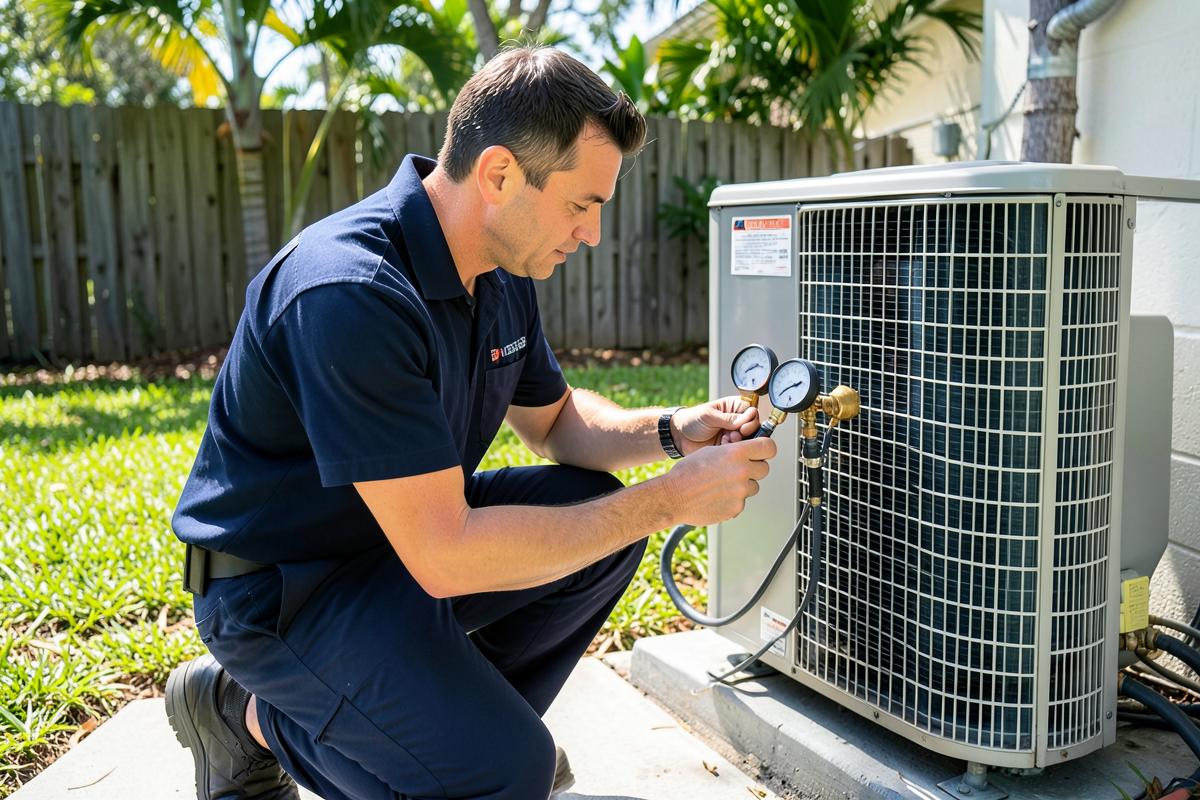
Refrigerant circuit readings
Suction and liquid pressures are typically taken, superheat and subcooling calculated, and the temperature split across the coil measured. Together these readings help confirm whether the charge and the compressor are performing correctly.
- 6
Findings and options
Homeowners are generally given the measured readings, the identified cause, and each available option with its cost. If a system's age makes replacement worth considering, that comparison is often included.
- 7
Authorized repair
Repair work generally begins only after the homeowner approves it. Common parts may be available the same visit; less common components are sometimes ordered and scheduled for a return visit.
- 8
Verification
After a repair, the same measurements are typically taken again to help confirm the system is operating within specification, not simply running.
Need air conditioning service in Port St. Lucie?
Call to describe the symptoms, or submit a service request with details about the problem so available scheduling options can be discussed.